

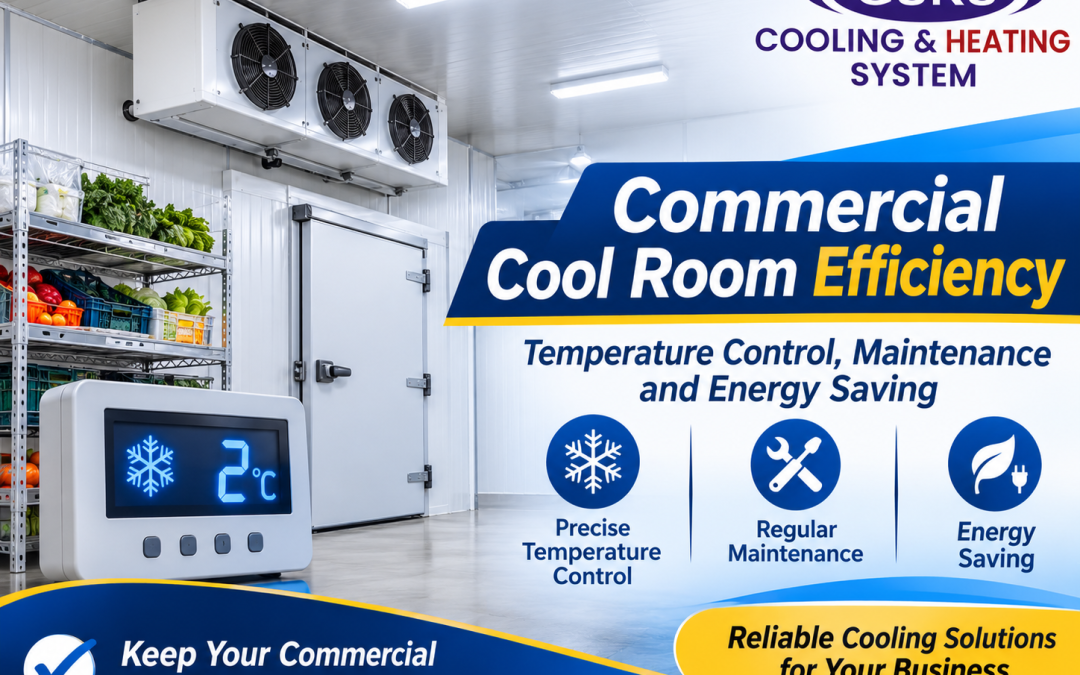
Commercial cool rooms and freezer rooms play an important role in businesses that depend on controlled storage conditions. Restaurants, food retailers, hospitality venues and other commercial operations may rely on refrigeration equipment throughout the day and night.
When a refrigeration system is not operating correctly, the consequences can extend beyond higher electricity consumption. Temperature fluctuations, equipment faults and unexpected breakdowns can affect stock, daily operations and business continuity.
Maintaining a commercial refrigeration system therefore requires more than simply checking whether the room feels cold. Temperature control, insulation, equipment condition and operating practices all contribute to reliable performance.
1. Why Commercial Refrigeration Efficiency Matters
Refrigeration equipment can represent a significant share of a business’s electricity consumption.
According to Australian Government energy guidance, refrigeration can account for approximately 25% to 85% of total company energy use, depending on the business.
This makes refrigeration performance an important consideration for businesses looking to manage operating costs.
An inefficient system may run for longer than necessary, struggle to maintain the required temperature or experience unnecessary heat gain.
Understanding the factors that influence performance is the first step towards improving the operation of a cool room or freezer room.
2. Maintain Consistent Temperature Conditions
Different products and storage applications have different temperature requirements.
For example, Australian Government guidance identifies typical design temperatures of:
- Cool rooms: approximately 0°C to 4°C
- Freezer rooms: approximately -18°C to -20°C
These are general reference points, not universal settings for every product or application. Businesses should follow relevant food safety requirements, product specifications and operating procedures.
Why Temperature Monitoring Is Important
A temperature display can show the current reading, but regular monitoring provides a better understanding of how the system performs over time.
Businesses should consider:
- Checking temperatures at appropriate intervals
- Keeping records of temperature readings
- Investigating unexpected fluctuations
- Checking the accuracy of temperature sensors
- Reviewing thermostat and defrost settings
If temperatures regularly move outside the required range, the underlying cause should be investigated rather than repeatedly adjusting the thermostat.
3. Check Door Seals and Insulation
Insulation plays an important role in limiting unwanted heat transfer.
Damaged panels, gaps around doors and poorly sealed service penetrations can allow warm air to enter the refrigerated space.
This can increase the workload on the refrigeration system.
Regularly inspect:
- Door seals and gaskets
- Wall and ceiling panel joints
- Floor and panel connections
- Pipe and cable entry points
- Insulation around the room
- Door closing mechanisms
For rooms with frequent access, rapid-close doors or suitable strip curtains may help reduce heat entering through doorways.
The Australian Government’s refrigeration energy guidance highlights insulation and effective door management as important efficiency measures.
4. Avoid Blocking Airflow Inside the Room
Air circulation is essential for maintaining consistent conditions throughout a refrigerated space.
Overstocking can obstruct airflow and make it harder for the system to distribute conditioned air effectively.
To help maintain suitable circulation:
- Keep air outlets and return paths clear.
- Avoid placing products directly against evaporator equipment.
- Maintain appropriate space around stored goods.
- Follow the manufacturer’s storage and loading recommendations.
- Avoid unnecessary overstocking.
The way products are arranged can influence how effectively the refrigerated space maintains its operating conditions.
5. Schedule Preventive Maintenance
A refrigeration system operates through several connected components. A problem with one component can affect the performance of the wider system.
Scheduled maintenance can help identify developing issues before they lead to a major failure.
Depending on the equipment and manufacturer’s recommendations, maintenance may involve:
- Inspecting the refrigeration system
- Checking evaporator and condenser condition
- Reviewing electrical connections and controls
- Checking temperature sensor operation
- Inspecting door seals and insulation
- Reviewing refrigerant-system performance
- Checking defrost operation
- Identifying unusual noises or operating conditions
Maintenance requirements vary according to the system, usage and operating environment. A suitable service schedule should be established for the individual installation.
6. Recognise Early Warning Signs
Businesses should not ignore changes in refrigeration performance.
Common warning signs include:
Temperature Fluctuations
If the room cannot maintain its required temperature, the equipment may need inspection.
Unusual Noises
Unexpected vibration, rattling or other unusual sounds may indicate a mechanical or operational issue.
Excessive Ice Build-Up
Unusual ice accumulation may be associated with airflow, defrost, door or other system problems.
Longer Operating Cycles
If equipment appears to run continuously or takes longer to recover temperature, its performance should be checked.
Water Leaks
Water around equipment or inside the room should be investigated to identify the source.
Early investigation can help businesses understand whether maintenance or repair is required.
7. When Should a Business Consider an Upgrade?
Older refrigeration equipment may become less efficient as components deteriorate or operating requirements change.
An upgrade may be worth investigating when:
- The system frequently requires repairs.
- Temperature control has become unreliable.
- The business has expanded its storage requirements.
- Existing insulation is no longer suitable.
- Equipment capacity does not match current usage.
- Energy consumption is consistently higher than expected.
The Australian Government notes that an efficient new refrigeration system can offer substantial energy savings compared with an older system. However, the actual result depends on the existing equipment, design, operating conditions and replacement system.
A replacement should be designed around the business’s actual storage needs rather than simply selecting a larger unit.
8. Plan for Reliable Commercial Refrigeration
Commercial refrigeration should be treated as an important part of business operations.
Regular monitoring, suitable insulation, effective door management and preventive maintenance can all contribute to more reliable performance.
Guru Cooling & Heating System provides commercial cooling solutions, including cool room and freezer room installation and service, for businesses across Canberra and surrounding areas.
If your business is planning a new installation or needs attention to an existing system, discussing the application and storage requirements is a useful starting point.
Final Thoughts
A well-managed cool room or freezer room depends on more than refrigeration capacity. Temperature monitoring, insulation, airflow, operating practices and maintenance all influence performance.
By paying attention to these factors, businesses can make better decisions about their refrigeration equipment and reduce the risk of avoidable operational problems.
For commercial cooling requirements, visit Guru Cooling & Heating System to discuss your project.
Recent Comments